Wieliczka Salt Mine
Kopalnia Soli "Wieliczka"
- Wheelchair: Yes
- Elevator: Yes
Location
What to expect
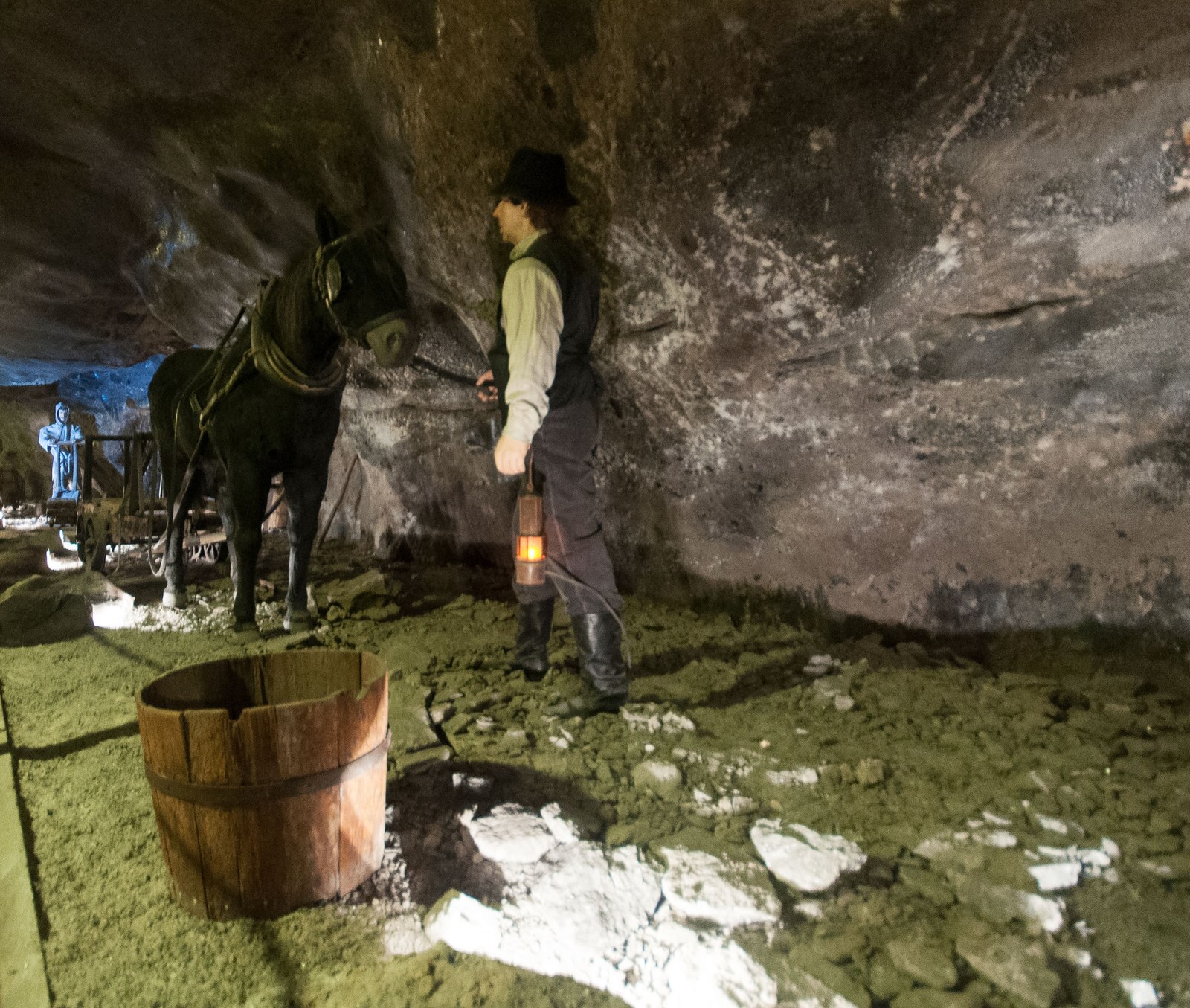
If you have two or more days in Krakow, give half of one to the Wieliczka Salt Mine. It suits first-time visitors to the region, families whose children can manage stairs on their own feet, and anyone curious about seven centuries of mining. The one group that should think twice: people with claustrophobia or serious breathing problems, whom the mine’s own rules send to a doctor first, since passages and the lift cage can be tight.
The format is fixed: 380 steps down, two to three hours behind a guide through chambers cut into rock salt, then a miners’ lift back up from 135 metres. The mine puts the route at about 3.5 km. There is no self-guided option; groups of up to 40 move together, and the guide speaks through a tour-guide device handed out before the descent. It stays 17-18 C underground all year, so bring a sweater even in July.
Most of the walk passes brine lakes, huge timber supports and the old machinery used to move salt. Then comes St Kinga’s Chapel, 101 metres down and roughly 54 metres long, where even the floor is a single block of salt and the chandeliers are salt crystals. The Last Supper relief on its wall was carved by a miner, Antoni Wyrodek. Photos for personal use are allowed.
English is not a problem. English tours are part of the regular schedule and, unlike German, French, Italian, Spanish, Russian or Ukrainian ones, can still be bought at the ticket desk if slots remain.
Tourist Route or Miners’ Route
For a first visit, book the Tourist Route: St Kinga’s Chapel is not on the Miners’ Route. The two never meet, because the Miners’ Route starts from the Regis shaft (pl. Kościuszki 9) and shares no section with the tourist trail. It runs in Polish and English only, costs the same as the Tourist Route in the same language, and only an online ticket guarantees a place. English speakers lose nothing here; visitors hoping for a German, French or Spanish guide do.
Here you do rather than listen. After a short briefing, groups of up to 20 set off in helmets and overalls, with a lamp and a carbon monoxide self-rescuer, to carry out mining tasks along 1.9 km, down to 101 metres. It suits a return visit, or teenagers who switch off on a lecture-style tour; the minimum age is 10.
A lift takes you down and back up, so the 380 steps disappear, but there are ladders and rough ground, and the mine does not open this route to visitors with reduced mobility. Closed shoes are compulsory. It is cooler, 14-16 C, and there are no toilets or snacks along the way.
Tips
- Book a timed slot online. The desks at the Daniłowicz shaft only sell what is left after online sales, and the mine warns the wait can then be long. Wikivoyage contributors report waits of several hours on busy days. Arrive at least 15 minutes before the time on your ticket.
- English costs 40 PLN more on a standard ticket. A standard ticket for an English-language tour costs 40 PLN more than the same route in Polish. Prices move with the season (lower from 1 October than in September), so read the figure for your date in the mine’s booking calendar. The guide fee is included either way.
- Decide on the museum underground. Your ticket also covers the Cracow Saltworks Museum exhibition on level III, another 1.5 km and 40 minutes to an hour. You choose at the end of the Tourist Route; if your legs have had enough, head straight for the lift.
- Note your exit shaft. The lift takes a few tens of seconds, but it may be the Daniłowicz, Regis or St Kinga shaft. Regis surfaces in Wieliczka’s town centre, about 800 m on foot from the ticket desks and left luggage; the mine offers a guided walk back to the Daniłowicz area.
- Travel light. Only bags up to 35 x 20 x 20 cm go underground. Suitcases and pushchairs go to the free left-luggage room in the “Górnik” building or to lockers, which can run out. Children under four are free, but their free ticket still has to be reserved.
- Stairs: only partly avoidable. You can pay for a lift down the Daniłowicz shaft, but places are not guaranteed. Wheelchair users can visit an adapted section of level II and the museum level with a companion, in Polish or English, on the first or last entry of the day, after booking at rezerwacja@kopalnia.pl .
- Cash and cards. There is an ATM near the Daniłowicz shaft, and every restaurant and shop on the mine site takes cards. The Karczma Górnicza restaurant, 125 metres down, serves Polish food.
- Expect no phone signal. Mobile networks do not reach the chambers; the mine provides one spot with free Wi-Fi. Toilets come up twice along the Tourist Route.
Getting there
Wieliczka is 12 km south-east of Krakow’s Main Market Square as the crow flies. Tourist Route visits start at the Daniłowicz shaft building, ul. Daniłowicza 10. You do not need an organised tour from Krakow to get here.
- Train: the SKA1 line from Kraków Główny to Wieliczka Rynek-Kopalnia takes 22-25 minutes and usually runs every half hour. The shaft is about five minutes’ walk from the station. This is the most reliable way to make a timed entry.
- Bus: line 304 from the Dworzec Główny Zachód stop by the Galeria Krakowska mall, 35-45 minutes; get off at Wieliczka Kopalnia Soli. The mine advises an agglomeration ticket covering zones I and II.
- Car: there are car parks at the Daniłowicz shaft and at the Graduation Tower, with free spaces for disabled drivers on the mine site.
Krakow and Wieliczka fit comfortably into one day: the mine in the morning, the city in the afternoon. On the way back the SKA1 train stops at Kraków Zabłocie, a few minutes’ walk from Schindler’s Factory.
Nearby
The Cracow Saltworks Museum in Wieliczka is the underground exhibition at the end of your route, on the same ticket. Its page explains what is on level III and why its castle above ground is closed. Back in Krakow, get off at Zabłocie for Oskar Schindler’s Enamel Factory , with its exhibition on the city under German occupation, and the MOCAK contemporary art museum next door. After 800 steps, two more museums in one afternoon is a plan for the determined.
Background
Rock salt was mined at Wieliczka from the 13th century until extraction stopped for good on 30 June 1996. Visitors, though, have been coming for more than two centuries: the tourist route took shape around 1800. In 1978 the mine was on UNESCO’s very first World Heritage list; it sat on the List in Danger from 1989 to 1998 and has been a Polish Historic Monument since 1994.
The whole mine spans nine levels and 245 km of passages and reaches 327 metres. In the mine’s own words, only “2% of the salt labyrinth” is open to visitors. Visitor numbers hovered around a million a year for much of the 2000s and peaked at 1.9 million in 2019. The Miners’ Route opened in September 2012 and, after a pandemic closure, reopened in April 2023.
Nearby museums
 History
Oskar Schindler's Enamel Factory
ul. Lipowa 4, 30-702 Kraków
Schindler's Factory in Krakow - the story of the city under occupation 1939-1945. Opening hours, tickets 60/45 PLN, free Mondays, book timed …
 Art
ArtMOCAK Museum of Contemporary Art in Krakow
ul. Lipowa 4, 30-702 Kraków
MOCAK Krakow - Museum of Contemporary Art in Zabłocie, next to Schindler's Factory. Hours Tue-Sun 11-19, tickets 30/20 PLN, free Thursday …