Museum of Road Engineering in Szczucin
Muzeum Drogownictwa w Szczucinie
Location
What to expect
A 1.5 km path coils across two hectares like a snail shell, and built into it are more than thirty stretches of real road surface from different eras - from cobblestones to modern asphalt. This is the road engineering museum in Szczucin, in Małopolska, southern Poland. You walk across generations of Polish road building. It is the only museum of its kind in the country, and the largest of the heritage sites run by GDDKiA, Poland’s national roads authority.
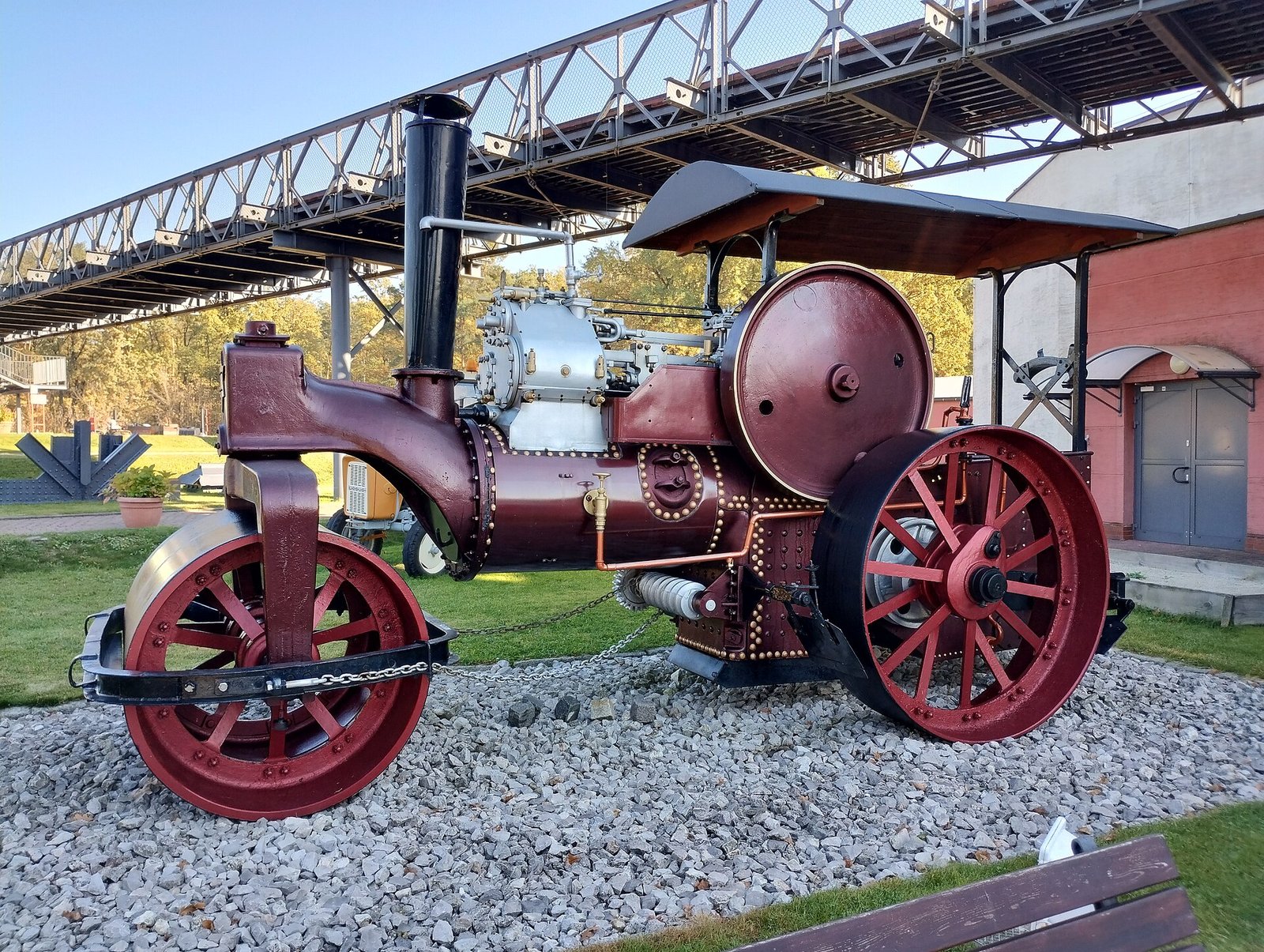
The open-air park holds heavy road-building equipment withdrawn from service, rollers included - among them a horse-drawn roller from the turn of the 19th and 20th centuries. Two exhibits break the pattern: a 51-metre Bailey bridge linking the main building to the machine park, and a narrow-gauge WLs40 locomotive rescued from a brickworks that no longer exists. There is also a Fiat 126p - the Polish “maluch” - converted into a snow plough, which tends to win over even the reluctant half of a travelling party.
Indoors the scale changes: surveying and measuring instruments, bridge designs, a model showing the stages of building a road, archive documentation, road service uniforms, maps, medals and photographs. The collection runs to more than a hundred objects in total.
Be clear about who this is for. If machines and industrial heritage interest you, it is a genuinely unusual couple of hours and free of charge. If you are looking for art, touchscreens or a rainy-day indoor option, skip it - most of the value is outdoors, static, and read rather than played with. The museum does not say whether captions exist in any language but Polish, so a visitor with no Polish may get the machines and not the story behind them.
Tips
- No booking needed for individuals. Walk in during opening hours; there are no tickets and no reservation system for single visitors. Only organised groups are asked to arrange a date in advance, by phone (+48 14 643 52 78) or e-mail.
- A weekend visit is outdoors only. The Saturday and Sunday opening from 11 April to 25 October covers the open-air exhibition. The instruments, bridge models and documents stay behind a locked door - come on a weekday for those.
- Allow 1.5 to 3 hours. The museum’s own figure is 1-3 hours and it is honest. An hour covers a brisk loop of the machine park; an afternoon if you read the plaques and add the indoor rooms.
- The road-surface trail is the thing to look for. Over thirty sections of genuine paving set into the walkway - the single element visitors name most often, ahead of the rollers themselves.
- Signage is in Polish. The museum publishes nothing about English labels and its own website is Polish-only. A translation app on your phone changes the visit substantially here.
- Check the forecast, not the timetable. The whole route is in the open with no shelter, so rain decides how good the visit is far more than the hour you arrive.
- Children under 13 need an adult, one per ten. The museum requires supervision for under-13s and for organised groups. The ratio is at least one adult to ten, which is worth knowing before a school trip.
- Two evenings in late June the site opens until 22:00. The Nocne Zwiedzanie (Night Visit) opens both the indoor and the outdoor exhibition. In 2026 it falls on 27 and 28 June, 14:00-22:00; dates are announced on the museum’s website.
Getting there
From Tarnów by car: Tarnów is the practical base, roughly 35-40 km south of Szczucin, about 45 minutes via Dąbrowa Tarnowska. The museum is at ulica 1-go Maja 39, right on national road 73, and parking on site is free, as is admission.
From Krakow by car: about 90 km and typically an hour and a half. Treat it as a day out in its own right, or as a stop on the Kielce - Tarnów route, not as an add-on to a day of sightseeing in the city.
By public transport: the workable option is a regional bus from Tarnów or Dąbrowa Tarnowska. There is no convenient direct rail link from Krakow, and if you come by bus, check the return departure before you set off - services are sparse.
Nearby
For another single-craft technical collection in Małopolska, the Museum of Locksmithing in Świątniki Górne applies the same principle: one narrow trade, taken seriously. The Museum of Phonography in Niepołomice is the logistical opposite - small, indoors, guided only and booking-required - which makes it a useful contrast with Szczucin’s walk-in park. In Krakow itself, the Museum of Engineering and Technology remains the largest technical collection, with historic trams and machinery under a roof.
Background
The museum began in 1982 as a memorial room attached to a road district office and grew alongside its collection, fed by equipment withdrawn from service across Poland. In May 1992 the whole site was entered in the provincial heritage register. Since 2005 its official name has been Zespół Historii Drogownictwa (Road Engineering History Unit), although everyone still calls it the Muzeum Drogownictwa.
It sits inside GDDKiA, the national roads authority, and is the largest of that body’s heritage sites; smaller road collections are kept in Zamość, Ciechocinek, Gdańsk-Matarnia and Skwierzyna. Szczucin gathers road-building heritage from the whole country, from hand tools and uniforms to heavy machines that cannot be seen working anywhere else.
Nearby museums
 Science
Museum of Engineering and Technology
ul. Świętego Wawrzyńca 15, 31-060 Kraków
Museum of Engineering and Technology Krakow in a historic tram depot. Hours Tue-Sun 10-18, tickets PLN 35/28, free on Tuesdays.
 Science
Polish Aviation Museum
al. Jana Pawła II 39, 31-864 Kraków
Polish Aviation Museum Krakow on the historic Rakowice-Czyżyny airfield. Tickets PLN 35/21, free Tuesdays; opening hours vary monthly - …
Cogiteon Małopolska Science Centre
ul. Stefana Steca 1, 31-866 Kraków
Cogiteon Krakow - Malopolska Science Centre. Interactive exhibits, labs and science shows. Opening hours, tickets 40/35 PLN, …