Podhale Museum in Nowy Targ
Muzeum Podhalańskie w Nowym Targu
Location
What to expect
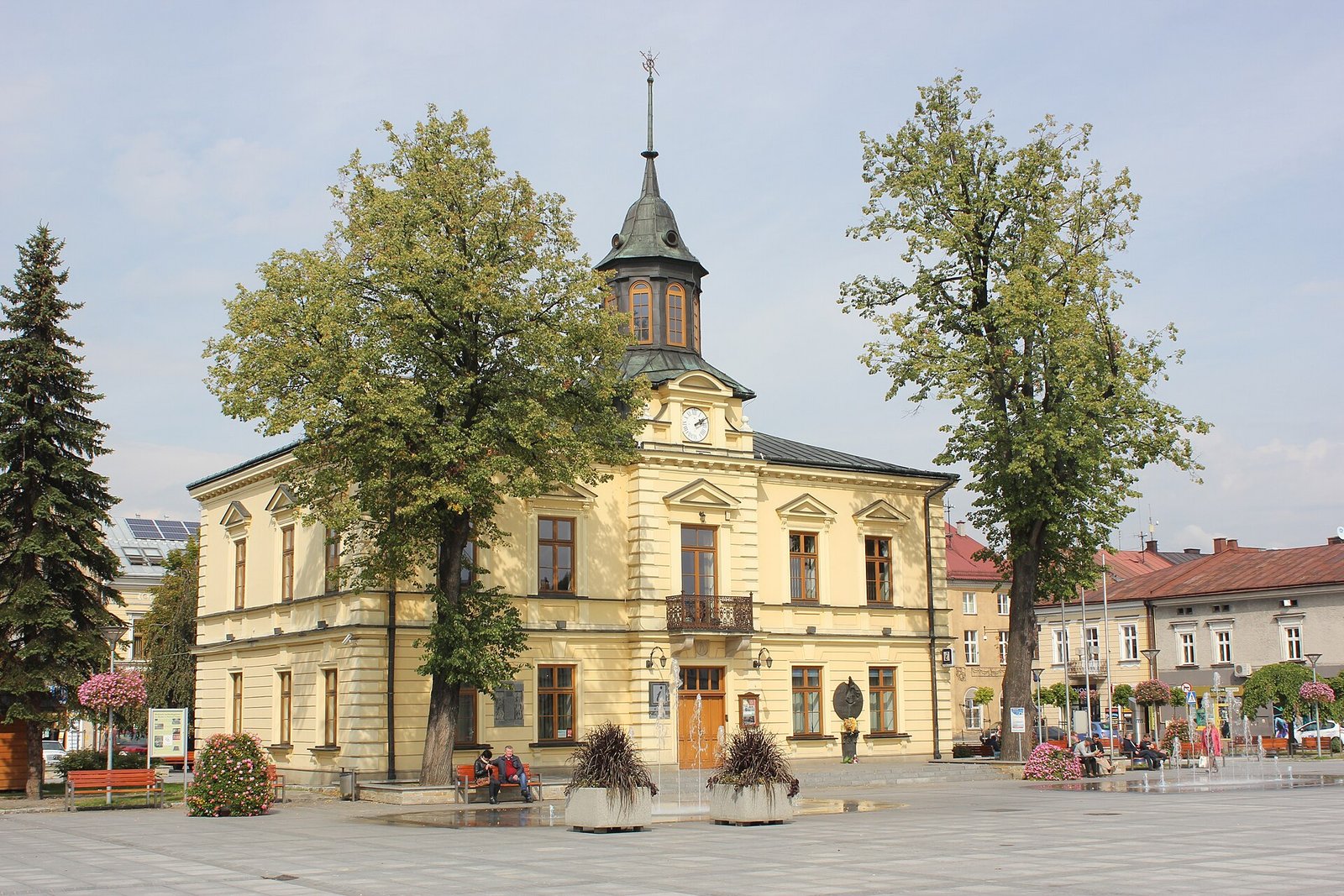
Nowy Targ is the town most visitors drive straight through on the way from Kraków to Zakopane. The Podhale Museum, in the town hall in the middle of the market square, explains what they are driving through. Its permanent exhibition is called “Nowy Targ na przełomie XIX i XX wieku, miasto którego już nie ma” - Nowy Targ around 1900, the town that no longer exists - and the title is accurate. There are no staged highlander costumes and no Tatra panorama here. There are workshops.
Shoemaking was the oldest guild in town, chartered in 1575. Furriery was chartered in 1624 and became the largest, with 79 furriers working here in the 19th century - sheep and skins were what the market town lived on. Then come hatmaking, with the wooden forms that felt was wound onto; weaving, with flax brakes and a loom; coopering, with the shaving horse and the moulds for oscypek cheese. After that, joinery with a decorated plane from 1825, and smithing with cylindrical bellows and a 19th-century hand lathe.
A separate room holds Podhale pottery: bowls, jugs, the double-pots used to carry a meal out to the fields, and the flasks in which Hungarian wine travelled through Nowy Targ on its way to Silesia.
The other part of the holdings is art: paintings by Michał Rekucki, ceramics by Jan Reczkowski and the sculpture of Edward Sutor. Sutor was self-taught, and the town’s own tourist office calls him “the Nowy Targ Nikifor”. It also says, unusually frankly for a promotional page, that his work “delights some people and provokes deep dislike in others”. Since 2011 there has also been a display on John Paul II’s ties with the town, including a chasuble, a zucchetto, a mitre and a pectoral cross.
Best for travellers who like objects, tools and how things were made, and for anyone curious about small-town Poland rather than about resort Poland. If you want the big Podhale story, start at the Tatra Museum in Zakopane instead: bigger, newer, busier. This one is cheaper, shorter and usually empty.
Tips
- Free on Tuesdays, all year round. In January, February, July and August Tuesday is also the first open day of the week, because the museum closes on Mondays in those months.
- Allow 45-60 minutes. The museum publishes no visit time; that is enough for the craft rooms and the papal display at an unhurried pace.
- Expect Polish. The museum says nothing about English labels and there is no audio guide. A guided tour costs 50 PLN per group and has to be arranged in advance - book it by phone or e-mail before you travel, not at the door.
- The famous printing press is not here. The 1848 Helbig & Müller press from Vienna, one of three known survivors worldwide, is at the Printing Museum on ul. Sobieskiego 4, under 100 m away and restored to working order. A combined ticket to both is 18/12 PLN instead of 20 PLN bought separately.
- The family ticket saves 1 PLN. The 2+3 family ticket is 40 PLN against 41 PLN for the same group bought individually - buy it for the convenience, not for the discount. Children under 7 enter free either way.
- The exhibition is on the first floor of a 19th-century town hall, and nothing is published about lifts or step-free access. If that matters, call +48 18 266 77 76 before you set out.
- Sundays are for groups only, by prior phone arrangement. There is no walk-in Sunday visit.
- Stand outside at noon. A bugle call has sounded from the tower at 9:00, 12:00, 15:00, 18:00 and 21:00 since 2005. The melody is the highlander song “Idzie Jasiek na zbój”, written by Józef Titz, who taught music to the young Karol Wojtyła in Wadowice.
Getting there
On foot: the museum is the town hall standing in the middle of the Rynek, a square of more than 1.5 hectares that still keeps its medieval plan. If you are on the square, you are at the door.
From the bus station: about 750 m, 10 minutes on foot to the north-east.
From the railway station on ul. Kolejowa: about 1.5 km, roughly 20 minutes on foot. Trains on the Kraków - Zakopane line call here.
From Zakopane: 22 km up the main road, about half an hour by car and a little longer by minibus. Easy to fold into a rainy afternoon.
From Kraków: about 85 km south. Allow 1.5 to 2 hours off-peak by car, and much the same by bus or minibus towards Zakopane. The museum publishes nothing about parking.
Nearby
- Tatra Museum in Zakopane - 22 km on, the same regional ethnography at full scale and with a newly rebuilt permanent exhibition. Seeing both makes the difference between a market town and a resort obvious.
- Władysław Orkan Museum in Rabka-Zdrój - about 20 km back towards Kraków. Orkan, the writer it commemorates, once addressed the townspeople from the iron balcony of this very town hall.
- Orava Ethnographic Park in Zubrzyca Górna - about 35 km. The tools you see here in cases stand there in the cottages they belonged to.
Background
The first collection in Nowy Targ was assembled before the First World War at the town’s gymnasium. The museum proper began with a motion that Czesław Pajerski put to a meeting of PTTK heritage guardians in Wieliczka in 1959. Collecting took seven years, the first exhibition opened in November 1966, and the founders showed visitors round unpaid; Pajerski served for years as the volunteer custodian and the museum now carries his name.
The PTTK “Gorce” branch ran it until the end of 2009, after which the town council handed the collections to the municipal culture centre. The museum moved several times before settling into the town hall in 1994. The building itself is older than any of that.
A town hall is recorded here in the 15th century, and the timber one burned in the town fire of 1601. The present neoclassical shape was given to it around 1900 by mayor Jakub Podkanowicz. The spire carries a sword, a torture wheel and a palm branch - the attributes of St Catherine, the patron saint of the town.
Nearby museums
 Culture
Seweryn Udziela Ethnographic Museum
pl. Wolnica 1, Kraków
The Ethnographic Museum Krakow shows Polish folk culture in Kazimierz's old town hall. Hours Tue-Sun 10-18, tickets PLN 20/15, free on …
 Art
ArtSukiennice - Gallery of 19th-Century Polish Art
Rynek Główny 3, 31-042 Kraków
Sukiennice Gallery of 19th-century Polish art above Krakow's Cloth Hall. Open Tue-Sun 10:00-18:00, tickets 35/25 PLN, free on Tuesdays.
 Art
ArtBishop Erazm Ciołek Palace
ul. Kanonicza 17, 31-002 Kraków
Bishop Erazm Ciolek Palace - medieval Polish art and icons near Wawel. Hours, tickets 18/14 PLN, free Tuesdays, directions.