Brama Grodzka - Teatr NN Centre
Ośrodek Brama Grodzka - Teatr NN
261 m from the Old Town Market Square in Lublin See museums near the Old Town Market Square in Lublin
- Wheelchair: No
Location
What to expect

The Grodzka Gate in Lublin is a museum you plan around rather than drop into. The exhibition “Lublin. Memory of the Place” can only be seen on a guided tour at fixed times, the English tour starts once each weekday at 12:00, and the Centre is closed on Sundays. Book that slot first, fit the rest of the Old Town around it, and have lunch afterwards.
Expect a route, not a gallery. It threads through four linked buildings - the gatehouse and numbers 21, 34 and 36 Grodzka Street - across 1,500 square metres, about 150 steps and many low doorways, mostly in half-darkness under artificial light. The rooms are lined with shelves of binders, each one devoted to a single house or a single resident of the former Jewish quarter. Lightboxes glow with Stefan Kiełsznia’s pre-war photographs of the city.
The setting does half the work. For centuries this gate led from the Christian Old Town down into the Jewish district of Podzamcze. The Germans destroyed that district during the war, in 1942-1943, and the open ground below the castle is what replaced it. The Centre puts the loss in one figure: in 1939 nearly 43,000 of Lublin’s 120,000 inhabitants were Jewish.
Online reviewers describe a labyrinth of rooms and leaving in tears. Their scores - 4.8 out of 5 from 439 Google reviews, 4.7 from 67 on TripAdvisor - are among the highest of any sight in Lublin.
Worth the detour for adults and for teenagers from 14, the age the Centre recommends, for anyone tracing Jewish Lublin, and for visitors heading to Majdanek who want to know whose lives ended there. Skip it with small children, or if being led by a guide for 75 minutes is not how you like to see a museum. Wheelchair users cannot visit at all: the Centre says plainly that its historic buildings are out of reach for them.
Tips
- Aim for the 12:00 English tour. It runs Monday to Friday; the Polish tours go at 10:00 and 14:00. Each lasts 75 minutes with up to 30 people, recommended from age 14. Miss noon and the only tour left that day is the 14:00 one in Polish.
- Expect to pay more in English. A foreign-language tour is 45 PLN full and 35 PLN reduced; the Polish tour is 35 and 20 PLN. Tickets are sold online at bilety.teatrnn.pl and at the Information Centre at 21 Grodzka Street.
- A private slot pays off only at nine. Outside the fixed times the Centre sells a tour for a group of up to nine at 400 PLN in a foreign language or 300 PLN in Polish. Eight adults on individual English tickets pay 8 x 45 = 360 PLN and nine pay 405 PLN, so only a full nine saves money (in Polish, 8 x 35 = 280 PLN against 300). A smaller party pays extra for choosing its own time.
- Groups of ten or more can pick any day. Organised groups can book a tour on any day of the week, even outside opening hours, with guiding in Polish, English, Hebrew, German, Ukrainian or Spanish.
- Look up the audio guide before you go. The Centre links a guide to the exhibition on izi.TRAVEL, which also comes as a text version. A deaf visitor should rely on it: the exhibition has no induction loop and no sign-language interpreter, though the desk keeps a communication card.
- Buy the 30-day pass at the desk. For 95 PLN (67 PLN reduced) it adds the House of Words, the Lublin Underground Route and the Cellar under Fortuna to this exhibition. It is not sold online, only at the Information Centre.
- Have a Sunday fallback. The Centre is closed on Sundays and opens on Saturdays only from May to September. No Saturday tour times are published, so book the out-of-hours slot or call +48 81 532 58 67 before a Saturday visit. On a Sunday the same story continues at the Chamber of Memory in the Chewra Nosim synagogue (13:00-15:00) and at Majdanek, which is free.
- Mind your head and your knees. There are about 150 steps and no lift, and not every stair has a handrail. The narrowest stairwell is 90 cm, and the doorway onto the exhibition is 80 cm wide and about 197 cm high. Many passages have low ceilings and door frames, and no toilet is adapted. Assistance dogs may come in.
- Budget well beyond the tour. The guided part is 75 minutes, yet visitors typically stay 1.5 to 4 hours. Leave the next slot of the day light rather than stacking another heavy museum.
Getting there
The entrance is at 21 Grodzka Street, the street that climbs from the Market Square to Lublin Castle. Anywhere in the Old Town or around the Krakow Gate is within a short walk.
- On foot: from the Krakow Gate, cross the Market Square and keep going - about five minutes. Coming up from Plac Zamkowy below the castle takes two or three minutes uphill. The Old Town is paved with rough granite setts, so leave heeled boots at the hotel.
- Bus and trolleybus: get off at Muzeum Narodowe - Zamek 01 or 02 at the foot of the castle hill, or at Brama Krakowska 02 or 04 if you come from the modern centre.
- By car: park in the paid car park on Plac Zamkowy, which has bays for disabled drivers and is not operated by the Centre. Do not try to drive into the Old Town.
- At the door: walk in through the Information Centre on the ground floor of number 21 rather than under the arch. Tickets, the pass and the guide all start from there.
Nearby
On a Sunday, when the Gate is shut, head to the Chamber of Memory of the Jews of Lublin on Lubartowska Street. It occupies the Chewra Nosim synagogue, the only pre-war synagogue still standing in the city.
On any other day the easiest pairing is the Lublin Underground Route , run by the same Centre and covered by the same pass. It leads through nearly 280 metres of cellars under the Market Square and ends with a moving model of the 1719 fire. Its entry times are different, so both fit into one day, and it is the lighter of the two.
Keep the State Museum at Majdanek for last, on the edge of the city - meet the people at the Gate first, then see the camp where their story ends.
Background
The institution began as a theatre. Tomasz Pietrasiewicz founded the NN Theatre in 1990, naming it after nomen nescio, the Latin for “name unknown”, and in 1992 the company took over the old gatehouse. Only then did it register that the neighbourhood the gate once opened onto had vanished, and the theatre turned into a memory institution. The building was restored from 1994 to 2000, and in 1998 the Centre became a municipal cultural institution.
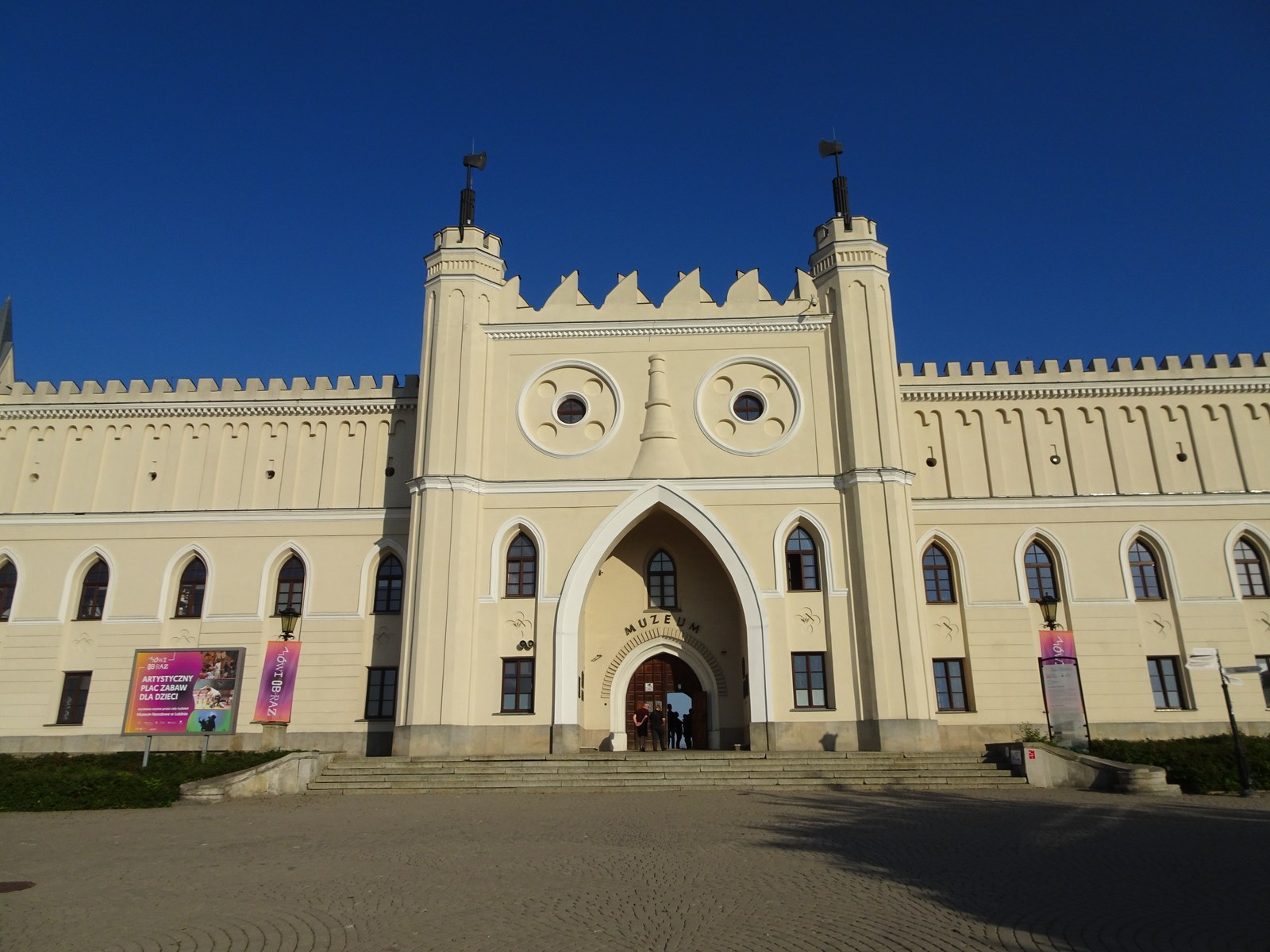
The gate itself is far older. It went up after 1342, when King Kazimierz Wielki allowed Lublin to build walls, and locals called it the Jewish Gate because it linked the Old Town with Podzamcze. Dominik Merlini, court architect to King Stanisław August, gave it its classicist face in the late 18th century.
The present exhibition dates from 2011, but much of the Centre’s work happens outside it. Since 2005, Letters to Henio has remembered Henio Zytomirski, killed at Majdanek aged nine. The Mystery of Light and Darkness marks the liquidation of the ghetto on 16 March 1942, and oral history recordings of Lublin residents go back to 1998. In 2013 the Centre won the European Citizen’s Prize.
Nearby museums
 History
National Museum in Lublin (Lublin Castle)
ul. Zamkowa 9, 20-117 Lublin
The National Museum in Lublin fills the castle hill: a Gothic chapel frescoed in 1418, a 13th-century keep with a viewing terrace and nine …
Museum of the History of the City of Lublin
Pl. Łokietka 3, 20-109 Lublin
The Krakow Gate in Lublin holds the city history museum: Lublin from its earliest settlement to 1944, and a panorama 36 metres above the …
 Culture
Józef Czechowicz Literary Museum
ul. Złota 3, 20-112 Lublin
Józef Czechowicz Museum in Lublin: the literary branch of the National Museum at Złota 3, holding the poet's manuscripts. Admission 10 PLN, …