Nikifor Museum in Krynica-Zdrój
Muzeum Nikifora w Krynicy-Zdroju
- Wheelchair: Yes
Location
What to expect
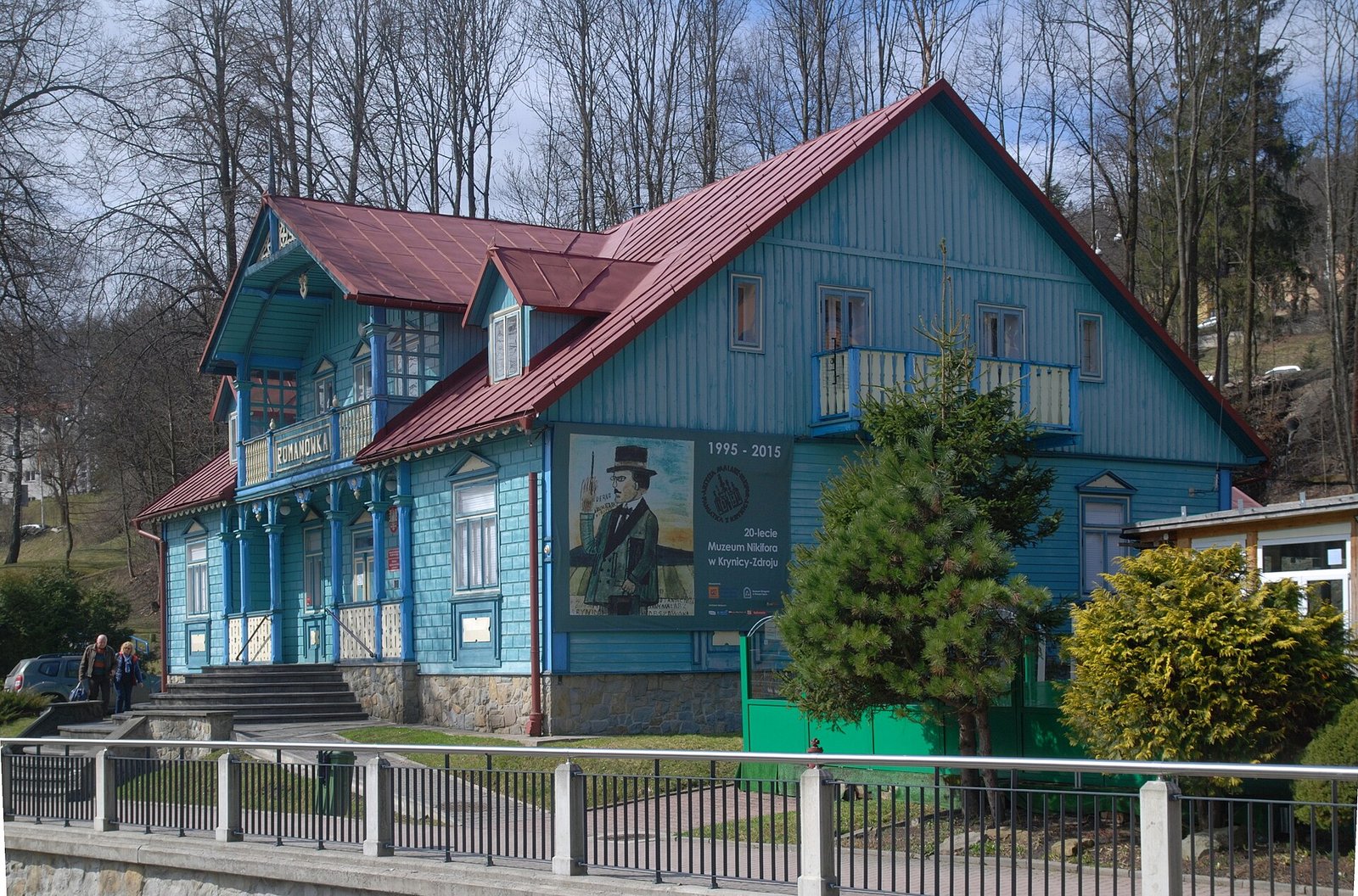
A pale blue wooden villa on the Krynica promenade holds the pictures of a man who sat a few steps away for half a century, painting watercolours on scraps of paper. Epifaniusz Drowniak, who signed himself Nikifor Krynicki, was a Lemko with no schooling and speech so indistinct that almost nobody understood him; he left roughly 40,000 works. The Nikifor Museum has been here since 1995, showing his pictures alongside his belongings in the same rooms. Wikipedia puts the display at 77 pictures; the museum publishes no number.
The display fills a handful of small rooms hung with watercolours, gouaches and drawings - Orthodox churches, railway stations, interiors, invented architecture, self-portraits. Beside them stand his own things: the wooden chest where he kept his work and slept, the travelling case of paints and brushes, the stamps he signed pictures with, his hat and waistcoat. One case holds an 86-page prayer book he drew by hand. Visitors also single out the sketches he never coloured before he died, and two atypical kitchen interiors.
A side room screens film of Nikifor painting propped against a wall with a stray dog at his feet, and that is where most people stay longest. Come if self-taught, naive or outsider art is your thing, or if Poland’s 2004 film “Mój Nikifor” sent you here. Children from about six take to the pictures easily, because the drawing looks like their own. If you want a large gallery or a multimedia exhibition, this is the wrong building.
Tips
- Free on Thursday, but the doors shut at 15:00. Admission is free on Thursdays, and Thursday is also one of the two short days, closing at 15:00 with last entry at 14:30. A free visit has to be a morning visit.
- The museum closes for lunch. On Tuesday, Wednesday, Friday and Saturday the rooms shut between 13:00 and 14:00. Arriving at 13:15 means waiting outside.
- Allow an hour, not twenty minutes. The pictures take about 45 minutes; the film in the side room adds the rest.
- Ignore the prices on travel portals. Third-party pages still quote 14, 21 or 22 PLN. The museum’s own list has said 24 PLN standard and 19 PLN reduced since 1 May 2026; a family ticket for two adults and two children under 16 is 73 PLN. The museum publishes no online ticket sales.
- The free app is the audio guide. The museum’s own app carries an audio guide to the rooms, audio descriptions of picture details, a guide with Polish Sign Language films and a separate audio guide for families with children. What it does not publish is the language of the wall labels, so do not count on English text - the pictures carry the visit either way. Live audio description and a PJM interpreter are arranged with the accessibility coordinator, Daniel Lachor, by SMS to 605 289 154 or e-mail to d.lachor@muzeum.sacz.pl ; the interpreter needs two weeks’ notice.
- Step-free entry is on the right. The front door is up high stone steps; a paved path and a ramp run along the right-hand side of the building. The toilet between the exhibition rooms is accessible and has a baby changing table.
- There is no museum car park. Paid public spaces nearby are the only option, including one bay for drivers with disabilities.
- Finish outdoors. A bronze Nikifor sits on a bench with his brush and his dog at the head of the promenade, unveiled in September 2005. In the old cemetery his headstone, carved by Bolesław Chromy, gives his name in Latin letters and, added years later, in Cyrillic - the Lemko half of the story the rooms only hint at.
Getting there
Krynica-Zdrój sits about 120 km south-east of Kraków in the Beskid Sądecki mountains. This is a full day out of Kraków, and the museum is one hour of it rather than the reason for the trip.
- By car: two and a half to three hours from Kraków via Nowy Sącz. The museum has no parking; use the paid zone in the centre.
- By train: from Kraków normally with a change at Nowy Sącz, to Krynica-Zdrój station.
- By bus: long-distance minibuses run from Kraków to the centre of the resort.
- On foot: a short walk from the station along the Kryniczanka stream. The Romanówka villa stands on Bulwary Dietla opposite the Old Spa House and is visible from the promenade - a pale blue timber building on that stretch.
Nearby
- Karwacjan Manor Art Gallery in Gorlice - about 40 km north, the nearest place in the region that programmes art rather than local history, and the obvious second half of the day if you came for painting.
- Museum of the Biecz Land - a Renaissance townhouse and a Gothic tower house some 55 km away, telling a town’s story where Krynica tells one man’s.
- Ethnographic Museum in Kraków - Polish folk and non-professional art at national scale, the context a few rooms in a spa town cannot supply.
Background
Romanówka is a 19th-century wooden guesthouse built in the Swiss-Alpine manner common to Carpathian spas. It originally stood on ul. Piłsudskiego, was dismantled in 1990 and reassembled on Bulwary Dietla between 1992 and 1994. It is a listed monument on the Małopolska Wooden Architecture Trail. The museum opened inside it in 1995 as a branch of the institution in Nowy Sącz, today called Muzeum Ziemi Sądeckiej. That institution holds the world’s largest Nikifor collection, more than a thousand items, rather more than the 77 shown here.
Nikifor was born in Krynica in 1895. The Ukrainian painter Roman Turyn noticed his work around 1930 and carried it to Paris. In 1947 Operation Vistula, the forced resettlement of the Lemko and Ukrainian population, deported him to western Poland; he walked back to Krynica three times and was allowed to stay after the third attempt.
The Kraków critics Ella and Andrzej Banach promoted him from 1949, and exhibitions in Paris and across Europe followed between 1958 and 1961. The painter Marian Włosiński looked after him from 1960 until his death from tuberculosis in 1968.
Nearby museums
 Culture
Seweryn Udziela Ethnographic Museum
pl. Wolnica 1, Kraków
The Ethnographic Museum Krakow shows Polish folk culture in Kazimierz's old town hall. Hours Tue-Sun 10-18, tickets PLN 20/15, free on …
 Art
ArtNational Museum in Krakow - Main Building
al. 3 Maja 1, 30-062 Kraków
National Museum in Krakow, Main Building - 20th-century Polish art, design and major temporary shows. Tue-Sun 10:00-18:00, tickets 45/35 …
 Art
ArtSukiennice - Gallery of 19th-Century Polish Art
Rynek Główny 3, 31-042 Kraków
Sukiennice Gallery of 19th-century Polish art above Krakow's Cloth Hall. Open Tue-Sun 10:00-18:00, tickets 35/25 PLN, free on Tuesdays.