Józef Mehoffer House
Dom Józefa Mehoffera
656 m from Rynek Główny in Krakow See museums near Rynek Główny in Krakow
- Wheelchair: No
- Elevator: No
Location
What to expect
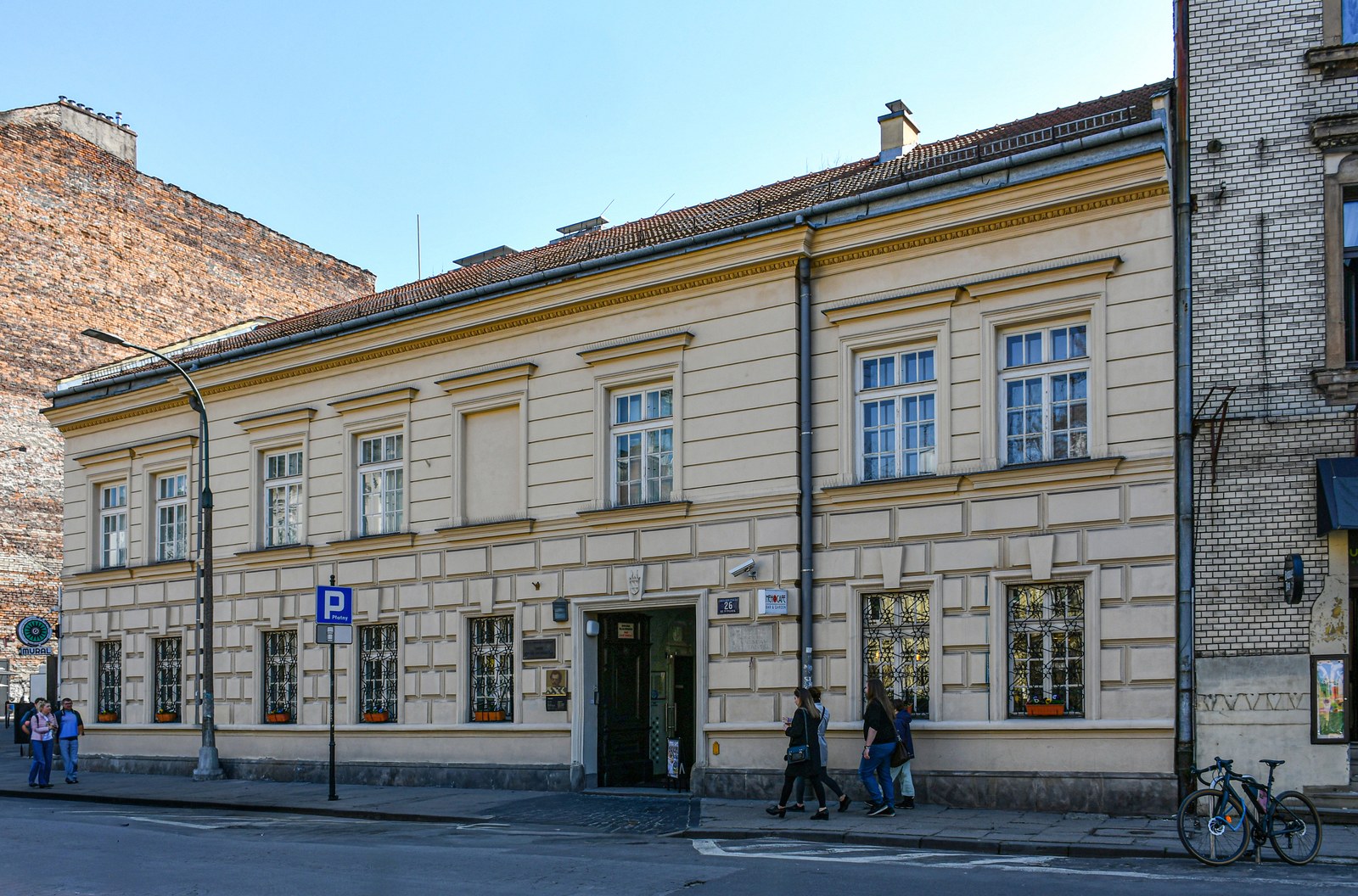
Ten minutes on foot from the Main Market Square, at Krupnicza 26, a painter’s house has been left more or less as he left it. Sixteen rooms over 400 square metres, with Józef Mehoffer’s own furniture, paintings and family possessions still in place. This is not a gallery of borrowed works but the last home of a central figure of Young Poland - Poland’s version of Art Nouveau - who lived here for fourteen years. The house also has a second claim on Krakow: Stanisław Wyspiański, the artist Mehoffer competed with all his career, was born in it on 15 January 1869.
Mehoffer kept the garden-facing ground floor for entertaining - dining room, library, a drawing room opening onto the terrace. The private rooms are upstairs, including a Japanese room; his grandson gave the museum around fifty Japanese woodblock prints. The furniture is genuine and stylistically mixed: Biedermeier sofas and beds, Louis-style chests and writing desks, Empire and Neoclassical odds and ends. Of the paintings, look for “Portrait of the Artist’s Wife against Pegasus” and “At the Summer Lodging”; of the stained glass, “Caritas”, “Vita somnium breve” and “Faith, Hope and Love”.
The easiest thing to walk past is the detail that named the house. The family called it “Pałacyk pod Szyszkami” - the little palace under the pine cones - after the carved wooden cones in the hallway and on the staircase. On that same staircase Mehoffer had baroque woodcarving installed along with copies of stone keystones from Wawel cathedral, and had the coke stove cased to look like an ornamental fireplace.
Go if you like period interiors, antique furniture, or the generation that made Krakow an art capital around 1900. Do not go expecting Mehoffer’s famous canvases: “The Strange Garden” and “May Sun” hang at the National Museum in Warsaw, and his large-format works are at MNK’s Main Building. Visitors report that the room documentation is in English as well as Polish - unusually good for a Polish house-museum, though the museum itself publishes nothing about label languages. Google reviewers rate the house 4.6 out of 5 across roughly a thousand reviews; the recurring grumbles are harsh lighting and unsmiling staff.
The garden is a reason to come in its own right, and you do not need a ticket for it. MNK restored it in 2003 from Mehoffer’s own paintings and archive documents, keeping the old elm and poplars. It opened to the public on 20 May 2004 and won Poland’s “Sybilla 2004” heritage award.
Set your expectations, though: this is 0.16 hectares between tenement blocks, not a park, and Polish writers have called it slightly overgrown. Under-sixes are through the house in a quarter of an hour and only start enjoying themselves out here. Children can run on the grass, and in season the Meho Cafe operates in it - good for a coffee, less convincing as a lunch stop.
Tips
- Last admission is 20 minutes before closing. Wednesday to Sunday the house shuts at 16:00, so the real cut-off is 15:40. Tuesday is the one long day, closing at 18:00 with last entry at 17:40.
- Allow an hour inside, half an hour in the garden. Walking the rooms takes about 45 minutes. Read everything and sit down outside and you have filled two hours.
- A Sukiennice or Main Building ticket already covers this. Per MNK’s price list, a ticket to the Sukiennice gallery, the Main Building or the Czartoryski Museum also admits you to the permanent exhibitions of several branches, this one included. Do not pay twice.
- Cheap does not only mean Tuesday. Tuesday is the free day for the permanent exhibition, but pupils and students pay 1 PLN on any day, children under 7 are free, and the family ticket is 36 PLN. A 12-month pass to every MNK branch except the Czartoryski Museum costs 300 PLN, or 200 PLN reduced.
- There is no audio guide here. MNK’s price list offers audio guides at seven branches and this is not one of them. A booked guide is the alternative - 170 PLN in Polish, 220 PLN in a foreign language, plus admission, through +48 12 433 57 44 or rezerwacja@mnk.pl .
- No lift, and prams stay downstairs. Two steps at the door, two floors of exhibition, and the pram goes to the cloakroom along with your coat and bag. A ramp leads into the garden, which a wheelchair or pram can reach.
- MNK contradicts itself on the accessible toilet. Its summary list of facilities names this branch among those with an accessible toilet and a changing table; the entry for the same branch on the same page says there is none. If that decides your visit, call +48 12 433 58 80 first.
- First Wednesday of the month, 14:00-16:00: quiet hours. For the last two opening hours MNK dims and quietens every branch for autistic and highly sensitive visitors. No large groups and no guided tours during that window.
Getting there
Tram: the Teatr Bagatela stop (lines 4, 8, 13, 14, 18, 20, 24), then four minutes along Krupnicza.
Bus: lines 124, 152, 352, 424 and 502 use the same stop.
On foot: ten minutes from the Main Market Square, straight across the Planty ring past the Bagatela Theatre; about fifteen minutes from Kraków Główny railway station.
By car: Krupnicza is inside the paid parking zone and the museum has no car park of its own. The tram is faster.
Nearby
Five minutes away on plac Sikorskiego, the Stanisław Wyspiański Museum costs the same 18/14 PLN and is devoted to the man born in this house. MNK publishes a ready-made route across the two branches, budgeted at two and a half to three hours.
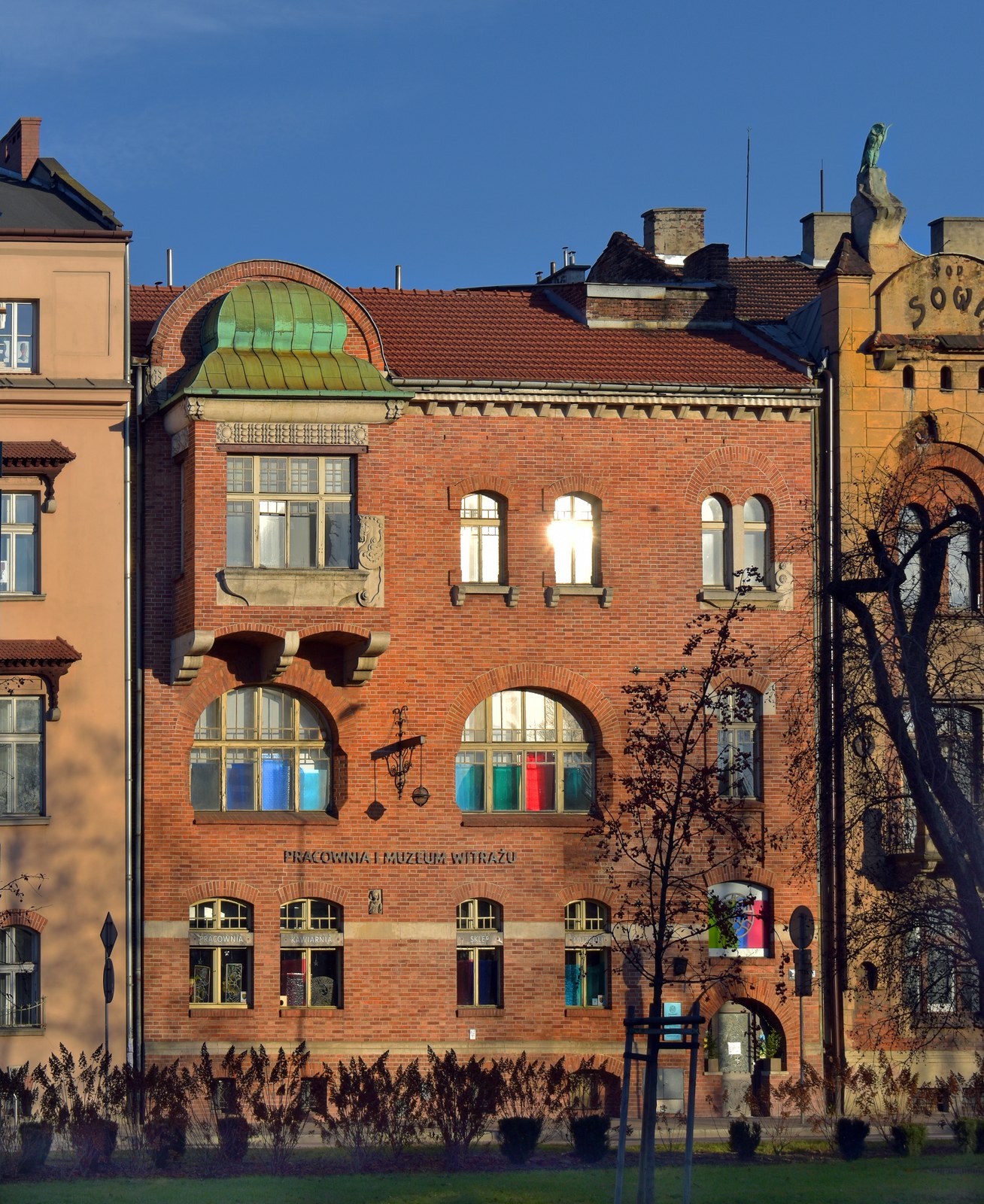
Towards the Błonia meadow, on al. Krasińskiego, the Stained Glass Museum is the working studio where both artists’ windows were actually made. Know the difference before you set off: entry there is by guided tour only, at fixed times, for 60 PLN, against 18 PLN and your own pace here.
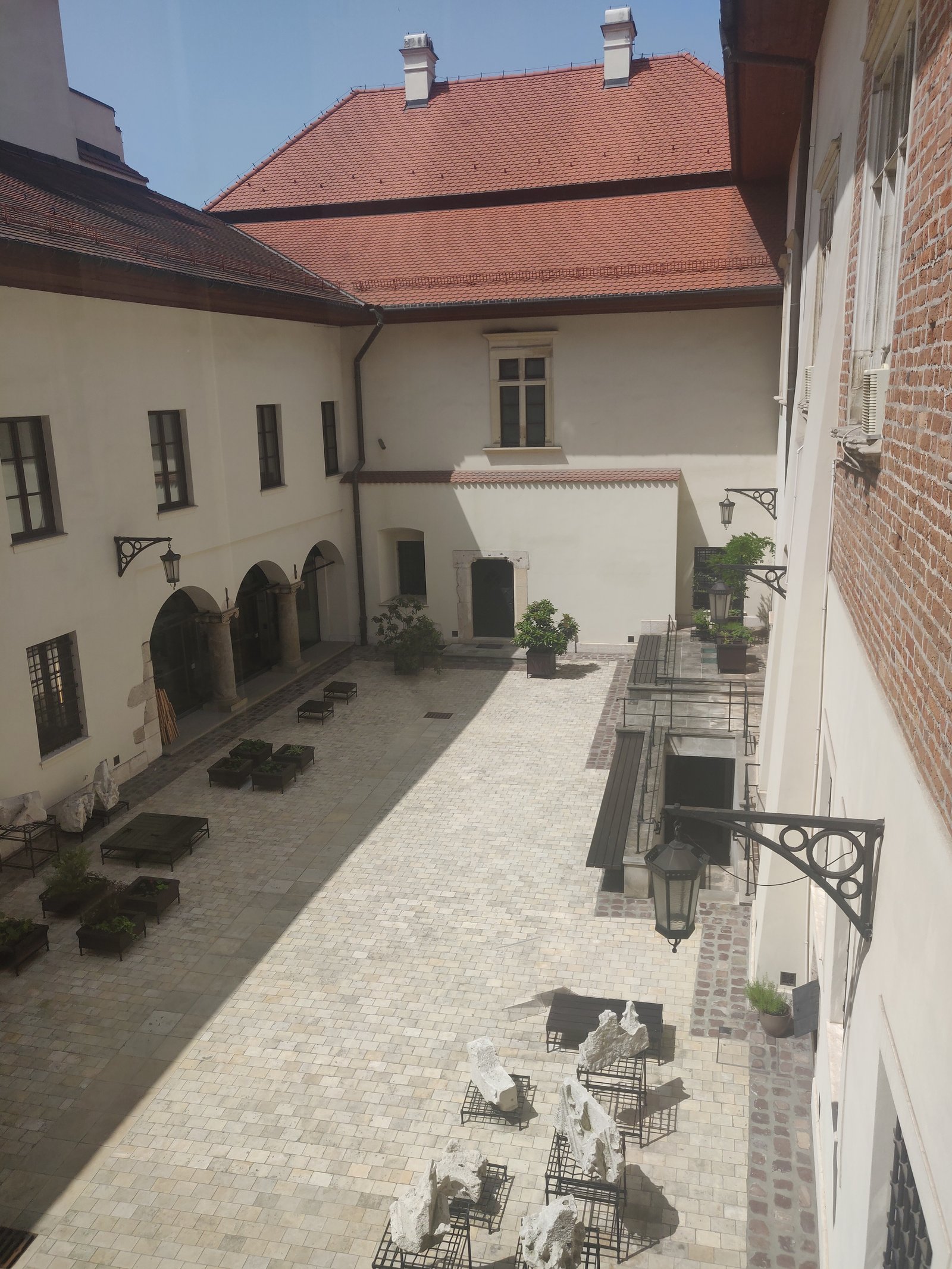
On Kanonicza, the Bishop Erazm Ciołek Palace holds old Polish and Orthodox art at the same 18/14 PLN - and unlike Krupnicza it has a lift.
Background
The wooden house on Krupnicza belonged to the Rogowski family, Stanisław Wyspiański’s maternal grandparents. After the Krakow fire of 1850 they rebuilt it in brick, finishing in 1852. It then entered the city’s history twice over: as a meeting place for conspirators during the January Uprising of 1863, and as Wyspiański’s birthplace.
The Szujski family bought it in 1872, and a year later Antoni Łuszczkiewicz rebuilt it for the historian and Jagiellonian University rector Józef Szujski, adding a floor and a central top-lit staircase. For the next four decades it was let out, partly as craft workshops, and fell into disrepair.
Mehoffer bought it in 1932 at the age of 63 and gutted it; the finishing work was still unfinished when war broke out in September 1939. The museum is his descendants’ achievement.
His son Zbigniew pressed for it from 1963 and died before it happened; his grandson Ryszard handed over the furniture in 1987 and the library, photographs and textiles between 1993 and 1995. The house passed to the state in 1986 and opened to visitors in 1996. In December 2023 MNK bought the complete set of 17 cartoons Mehoffer drew for the stained glass of Freiburg cathedral, a commission that occupied him from 1895 to 1936.
Nearby museums
 Art
ArtStained Glass Museum
al. Zygmunta Krasińskiego 23, 31-111 Kraków
Stained Glass Museum Krakow - a working stained glass studio. Guided tours Tue-Sat, English at 12:00 and 15:00. Hours, tickets, directions.
 Art
ArtStanisław Wyspiański Museum
pl. Sikorskiego 6, 31-115 Kraków
Wyspiański Museum Krakow - the world's largest collection of his art. Hours (Tue, Thu-Sun), tickets 18/14 PLN, free Tuesdays.
 Art
ArtBishop Erazm Ciołek Palace
ul. Kanonicza 17, 31-002 Kraków
Bishop Erazm Ciolek Palace - medieval Polish art and icons near Wawel. Hours, tickets 18/14 PLN, free Tuesdays, directions.