John Paul II the Great Museum in Krakow
Muzeum Jana Pawła II Wielkiego w Krakowie
5.3 km from Rynek Główny in Krakow See museums near Rynek Główny in Krakow
- Wheelchair: Yes
- Elevator: Yes
Location
What to expect
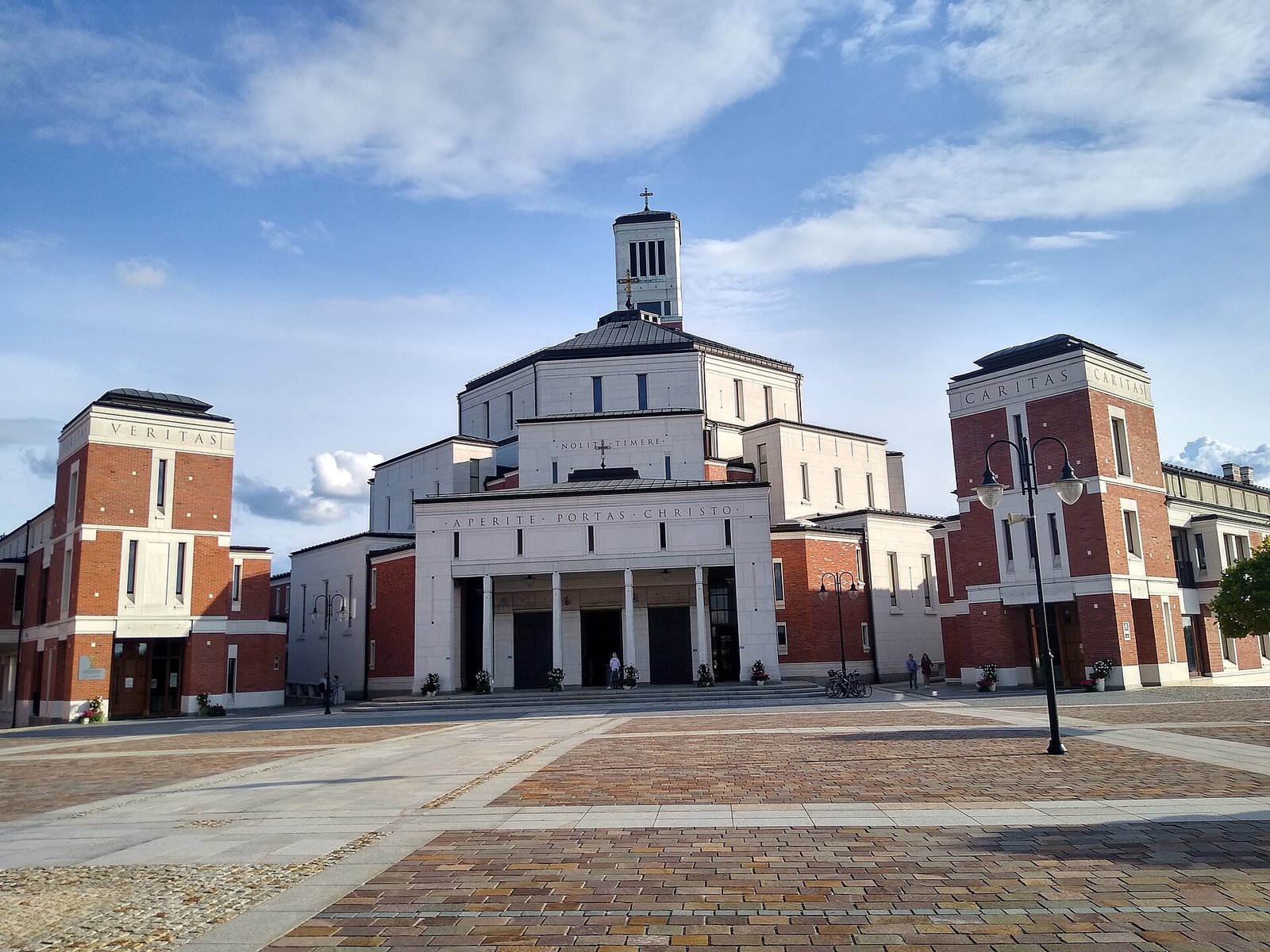
The John Paul II the Great Museum is one of three Krakow museums named after Karol Wojtyła or John Paul II, and the easiest to confuse with the others. It sits in Łagiewniki, beside the St John Paul II Sanctuary, over 5 km from the Main Square as the crow flies. The Archdiocesan Museum on Kanonicza shows where Karol Wojtyła lived; the Cathedral Museum on Wawel is a church treasury. This one holds what the world gave him as Pope.
Start with the main exhibition, “Our Pope” (“Nasz Papież”), and its two centrepieces. One is his bedroom from Franciszkańska 3, where he stayed on visits to Krakow, rebuilt with his bed, desk and computer, his books and the lamp left on. The other is a papal cassock draped over a white throne beside his ferula and stole. The collection also holds his 1990s laptop, his skis and ski jackets, and chalices from the 14th century onwards.
The gifts are grouped by theme rather than by date, following the Pope’s fourteen encyclicals in the four groups Joseph Ratzinger proposed. The biographical part is easier going. It opens with a pair of wooden work clogs recalling Wojtyła’s wartime labour at the Solvay chemical plant, which stood on this very land.
Two smaller shows sit alongside. “Who is the Man of the Shroud?” is one room with a copy of the Shroud of Turin, a hologram, a 3D reconstruction and a sculpture by Luigi E. Mattei; it argues for the cloth’s authenticity rather than surveying the scientific debate. “Karol Wojtyła in Trentino” fills 390 m² with film, photographs and rocks from the Italian mountains where he came to ski and rest.
Worth the trip if you are a pilgrim heading to Łagiewniki anyway, or you are following John Paul II through Krakow and Wadowice. Skip it if the Pope is not your subject and you have only a day or two: Kanonicza gives you Wojtyła in the Old Town without the tram ride. This is a collection of gifts and memorabilia presented by the Church, not an art museum.
Tips
- Buy two exhibitions, not one. One exhibition costs 20 PLN (15 PLN reduced), two cost 25 PLN, all three 35 PLN (25 PLN reduced). The second show is 5 PLN extra; pair “Our Pope” with the Shroud room.
- Allow 45-60 minutes per exhibition. That is our estimate - the museum publishes none. All three take around two hours. 16:15 is the last entry for a single exhibition and the museum closes at 17:00, so for all three arrive by about 15:00.
- Do not count on English labels. The museum publishes nothing on label languages; the one visitor report, a review from May 2024, says most explanations in the Shroud room are not in English. The English version of the museum’s website still shows its practical pages in Polish. Guided tours in English, Italian or Spanish cost 150 PLN for the guide and must be booked ahead; there are no guided tours on Sundays.
- The VR film has an English version. “The Way”, a virtual-reality film series on the Stations of the Cross, runs in Polish and English; 28 PLN buys up to two episodes.
- Winter Mondays are out. From November to March the museum closes on Mondays. It is also shut on 1 and 6 January, Good Friday through Easter Monday, 3 May, Corpus Christi, 15 August, 1 and 11 November and every day from 24 to 31 December.
- Phone first if this is your only reason to come. In March 2026 a visitor on TripAdvisor found the inner door locked during posted opening hours. The museum reception answers on +48 511 500 222.
- Go up the Fatima Tower at the weekend. The sanctuary’s tower costs 5 PLN and has a lift to a glass terrace about 50 m up; on a clear day you can see the Tatra peaks. From April to October individual visitors get in on Saturdays and Sundays, 10:00-18:00. On weekdays it opens only for booked groups of more than ten.
- No visitor rules are published. There is nothing online about photography, bags or card payment at the desk, so ask at reception before you take pictures and carry some cash. Lifts and accessible toilets are in place, and there is a café and a baby-feeding area.
Getting there
Train: the quickest link from the centre. Direct trains run from Kraków Główny to the Kraków Sanktuarium stop; the fastest takes 13 minutes on the EuroPodróże timetable.
Tram: lines 8, 19 and 22 to Borek Fałęcki, then about ten minutes on foot towards the footbridge by the Kraków Sanktuarium railway stop.
Bus: line 224 (Wieliczka - Centrum Jana Pawła II) stops at the complex itself. From the main station the museum suggests tram 50 to the Kurdwanów terminus and a change to the 224 there.
On foot from Divine Mercy: the Divine Mercy Sanctuary is about 600 m away as the crow flies. The walk over the Mercy Bridge (Most Miłosierdzia) and through the park takes 15-20 minutes, so the two sanctuaries fit into one half-day.
By car: park at the sanctuary. Approach via Herberta and Totus Tuus streets from Kurdwanów and the A4 motorway, or via Jugowicka and Marcika from Zakopiańska. Coaches have their own zone.
Nearby
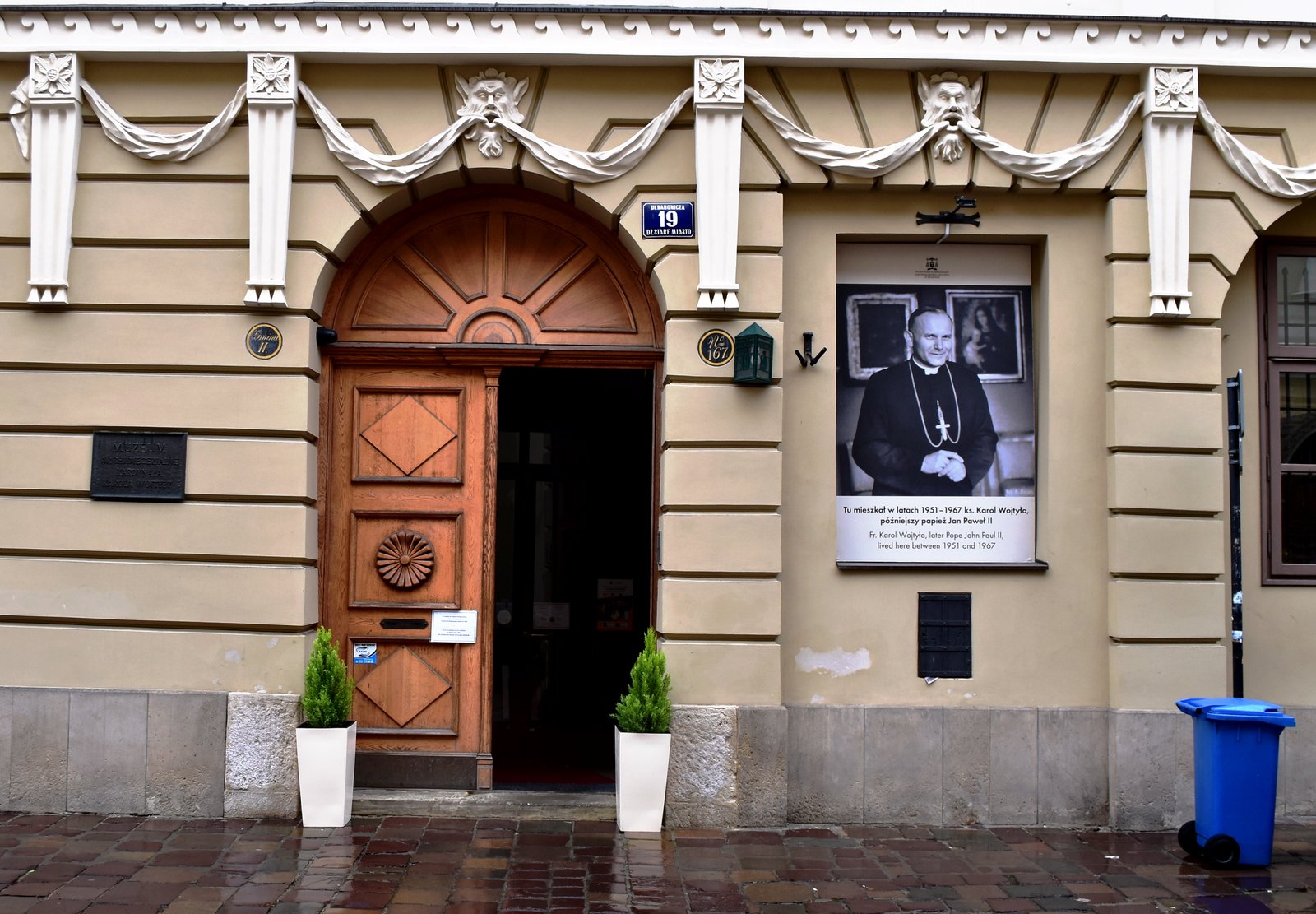
The natural companion is back in the Old Town: the Archdiocesan Museum on Kanonicza Street , which ran this place as its branch until 2020. There you see the flat Wojtyła lived in from 1951 to 1967, alongside sacred art. Here you see what came to him as Pope.
Keep both apart from the John Paul II Cathedral Museum on Wawel Hill , the cathedral treasury with a single papal room, covered by the Wawel Cathedral ticket. Closest to Białe Morza on our list is the Scouting Movement Museum in Fort Jugowice , 2.2 km as the crow flies.
Background
The Białe Morza site is the former industrial land of the Solvay soda works, where the young Wojtyła took a manual job in 1940 after the German occupation ended his studies. Work on the John Paul II Centre began here on 11 October 2008, to a design by the architect Andrzej Mikulski.
The collection predates the building. John Paul II passed his gifts on gradually around the turn of the century, and after his death his secretary, Cardinal Stanisław Dziwisz, handed over a large share.
The museum opened on 23 June 2013, the day the sanctuary’s upper church was consecrated, as a branch of the Kanonicza museum. “Our Pope” followed on 16 October 2018, and since 1 March 2020 the John Paul II Centre “Be Not Afraid” has run the museum directly.
Nearby museums
 History
Archdiocesan Museum in Krakow
ul. Kanonicza 19-21, 31-002 Kraków
Archdiocesan Museum Krakow on Kanonicza Street - sacred art and Karol Wojtyla's former home. Tickets 10/6 PLN, Tue-Sun 10:00-17:00.
John Paul II Cathedral Museum on Wawel Hill
ul. Wawel 3, 31-001 Kraków
Wawel Cathedral Museum in Krakow - the cathedral treasury on Wawel Hill, distinct from the Royal Castle. Polish regalia, open Mon-Sat 9-17.
Museum of the Scouting Movement
ul. Forteczna 28, 30-437 Kraków
Museum of the Scouting Movement in Krakow's Fort Jugowice - a Museum of Krakow branch on Polish scouting. Opening hours, tickets 20 PLN, …