Aleksander Kłosiński Museum in Kęty
Muzeum im. Aleksandra Kłosińskiego w Kętach
- Wheelchair: No
- Elevator: No
Location
What to expect
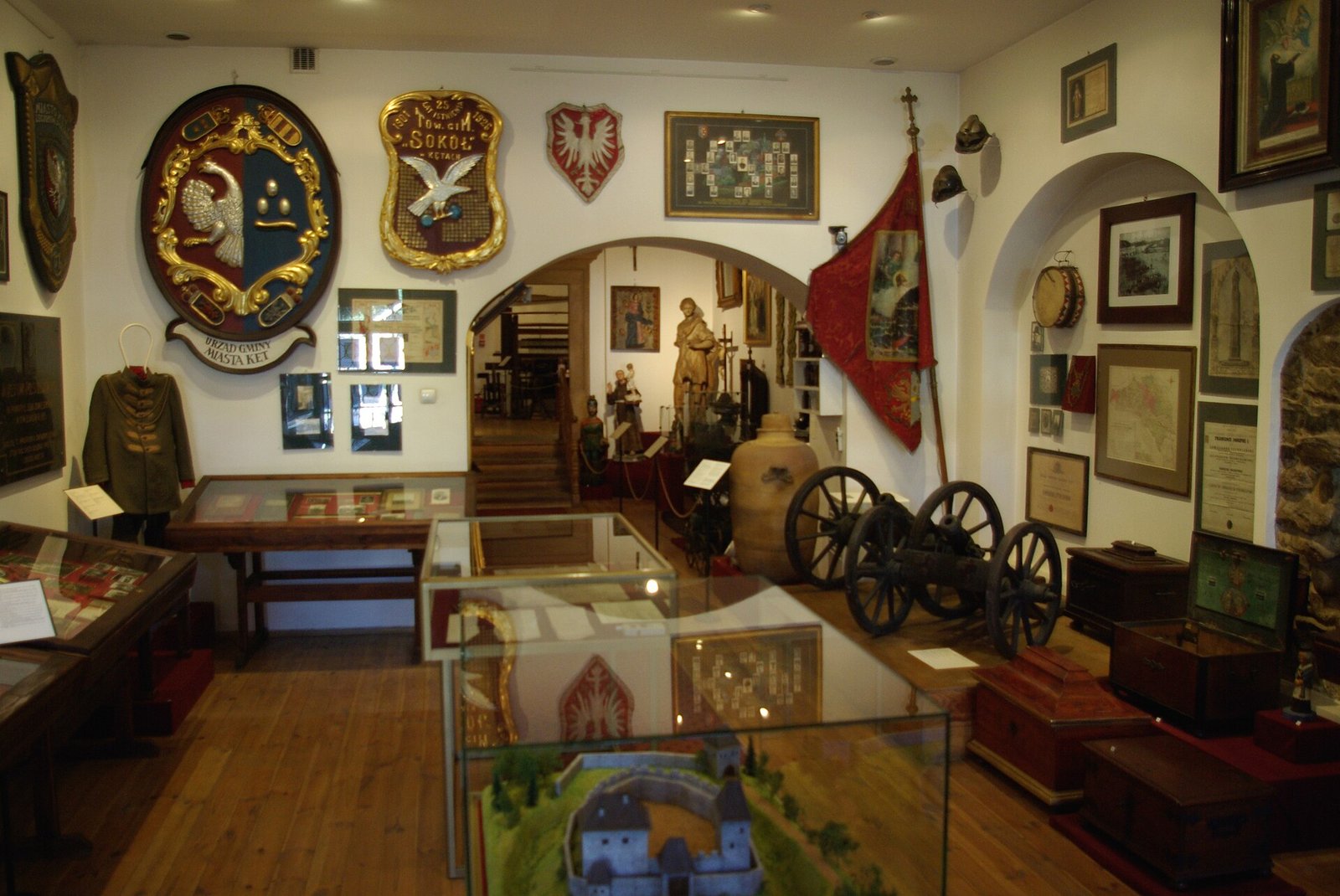
Around 4,400 objects that the people of Kęty carried into one townhouse on the market square over half a century. It began with one man: Aleksander Kłosiński (1892-1974) left the town the collection he had spent his life assembling, and in 1977 it became the Historical Collections of the Town of Kęty. The museum took his name in 1994 and moved into the house at Rynek 16 in 1995. It stands a few dozen metres from the monument to Saint John Cantius, a local boy who became a professor at the Kraków academy.
The permanent display has occupied the ground floor since 2005 and runs along three threads. The first is the official town: charters, guild chests, sacred art from nearby churches, Habsburg-era documents from after 1772, and material on the Polish Legions quartered here in the winter of 1915.
The second is the burgher home - a salon furnished in cherry-wood Louis-Philippe pieces, paintings including work by Jan Grabowski, and a reconstructed photographic studio from the early 1900s. The third is the countryside: farm tools, pottery from local kilns, and the “strój łaski”, the regional folk costume. The archaeology reaches back to the Hallstatt period, the 8th to 5th centuries BC.
One upstairs room holds the temporary exhibitions, and that room sets the museum’s rhythm. In 2026 it showed the cartography of Kęty from the 16th to the 20th century, then a display on the 20th-century school, and from July the 90th anniversary of the Porąbka dam. Entry to these shows is free, even when the permanent display is ticketed.
Be clear-eyed about what this is: a small municipal museum in a town of 17,600 people, written for a Polish audience. Its website has no English-language version, and it states no English labels or audio guide. If you do not read Polish you will get objects, interiors and dates, but not the story. It earns a visit if you are already in Oświęcim or Bielsko-Biała and want the ordinary, civilian counterweight to what the region is otherwise known for. It does not earn a day trip out of Kraków on its own.
Tips
- Sunday is the free day, but it is suspended until 27 September 2026. The museum’s notice states that it will be closed every Sunday from 23 August to 27 September 2026. Until then you visit on a weekday and pay: 8 PLN standard, 4 PLN reduced.
- Thursday is the only late day. It opens 12:00-17:00; Tuesday, Wednesday and Friday all close at 15:00. Monday and Saturday are closed all year, so a normal tourist weekend does not fit this museum.
- Allow 45-60 minutes. The museum publishes no suggested duration. The ground floor plus the temporary room fills an unhurried hour, or half an hour if only the temporary show is open.
- There is no online ticketing. Tickets are sold at the desk, and the museum does not publish whether cards are accepted, so bring cash to be safe. A guided tour costs 15 PLN and must be arranged by phone (33 845 31 07) or e-mail a few days ahead.
- Everything is in Polish. No foreign-language site, no advertised English labels or audio guide. Bring a translation app for the object captions, or take the guide and ask whether anyone on the staff can work in English before you travel.
- Do not miss the salon and the photographic studio. They are the only two parts of the display that are furnished rooms rather than cases, and the only parts that do not survive a look at photographs online.
- Ignore the museum’s own blog posts. The “frequently asked questions” pieces claim weekend hours of 10:00-18:00, Saturday opening, wheelchair access and multilingual guides, none of which the museum’s own hours table or contact pages confirm. Trust the table.
- Ask about accessibility before you travel. It is a historic townhouse and the museum publishes nothing about a lift or a step-free entrance; the site records no wheelchair access.
Getting there
By car from Kraków: about 55 km west, roughly an hour via Kalwaria Zebrzydowska and Wadowice. The museum sits directly on the Rynek, which is a small square - look for a space in the side streets rather than on it.
By car from Bielsko-Biała: 15 km on national road 52, about 15 minutes. This is the nearest large city and by far the shortest approach.
By train: Kęty is on line 117 between Kraków Główny and Bielsko-Biała, worked by Polregio via Kalwaria Zebrzydowska, Wadowice and Andrychów. One caveat: the operator has been running replacement buses on the Kęty - Bielsko-Biała Główna section during modernisation work, so check the timetable before you set out. The walk from the station to the Rynek takes a little over ten minutes.
By bus: national road 52 from Bielsko-Biała to Wadowice runs through the town and carries regional coach and minibus services; the central stops are a few minutes’ walk from the square.
Nearby
Fifteen kilometres north, the Castle Museum in Oświęcim tells the same borderland story with a tower, Gothic cellars and a 12 PLN ticket. In summer, from June to September, it also opens on Saturdays, which makes it the practical choice for a weekend; outside that season its Saturdays are closed too. Ten kilometres east, the Museum of History and Ethnography in Andrychów covers related ethnography for nothing, but publishes no opening hours at all and admits visitors only by arrangement. Further north-east, the Libiąż Regional Museum has closed and its building is up for sale. Against Andrychów’s visits by arrangement, Kęty’s fixed weekday timetable is the easier one to plan around.
Background
Kęty held town rights before 1267, received Magdeburg law in 1391 and became a royal town after 1457. Its museum, though, is a post-war story that grew out of one private obsession. Aleksander Kłosiński spent decades gathering documents, household objects and mementoes tied to the town; after his death the collection passed to the municipality, and in 1977 it opened to the public on ul. Mickiewicza.
From 1983 the Regional Museum in Bielsko-Biała held it in trust. In 1994 the institution took Kłosiński’s name, in 1995 it moved into the historic townhouse at Rynek 16, and in 2004 it became an independent cultural institution of the Kęty municipality. The current ground-floor display opened in 2005. The holdings have grown to some 4,400 objects, almost all of them donated by residents - this is still a museum assembled by its town rather than bought by it.
Nearby museums
 Culture
Seweryn Udziela Ethnographic Museum
pl. Wolnica 1, Kraków
The Ethnographic Museum Krakow shows Polish folk culture in Kazimierz's old town hall. Hours Tue-Sun 10-18, tickets PLN 20/15, free on …
 History
Archaeological Museum of Krakow
ul. Senacka 3, 31-002 Kraków
Archaeological Museum Krakow: during the rebuild only the prehistory of Małopolska is open. Tue-Sat 9-17, Sun 11-16, tickets PLN 15/10, free …
 History
Krzysztofory Palace - Museum of Krakow
Rynek Główny 35, 31-011 Kraków
Krzysztofory Palace on the Main Square - main seat of the Museum of Krakow and its city-history exhibition. Hours, tickets 34 PLN, free on …